Xing vs LinkedIn for recruiting : Which platform should you use?
If you're recruiting in the DACH region, you'll probably come across two names again and again: LinkedIn and XING.
Both platforms can help recruiters find candidates, build talent pools and connect with people who may not be actively looking for a new role. But they're built around different audiences and have different strengths.
So, which should you use?
The answer depends on where you're recruiting, the candidates you're looking for and how you prefer to source and engage with them.
In this guide, we'll compare LinkedIn and XING for recruitment, looking at candidate reach, search, sourcing, job advertising, messaging, automation and the tools available to recruiters.
XING vs LinkedIn at a glance
LinkedIn is a global professional network with more than 1 billion members worldwide. Its recruiting products are designed for organisations hiring at different scales, from occasional hiring through to large recruitment teams.
XING is much more focused geographically. It has more than 21 million members in the German-speaking market and positions XING TalentManager as an active sourcing solution for recruiters looking to find and approach candidates directly.
That means the choice isn't simply about which platform has more members.
If you're recruiting internationally, LinkedIn gives you access to a much broader candidate pool.
If you're recruiting specifically in Germany, Austria or Switzerland, XING's DACH focus can make it a particularly relevant source of candidates.
What is XING?
XING is a professional network focused on the German-speaking job market.
Today, XING positions itself primarily as a jobs and recruiting platform, helping candidates find opportunities and recruiters find talent in the DACH region.
For recruiters, XING TalentManager provides tools for searching for candidates, contacting them directly and building talent pools. XING says recruiters can search more than 21 million members using recruiting filters and candidate recommendations.
XING also provides features designed around active sourcing, including direct messaging, automatically generated message templates and candidate recommendations.
This makes XING particularly relevant if the majority of your recruitment activity is focused on the German-speaking market.

What is LinkedIn?
LinkedIn is a global professional network used by professionals, companies, recruiters and job seekers around the world.
For recruiters, LinkedIn combines candidate search, job advertising, direct outreach, talent management and employer branding in one platform.
LinkedIn Recruiter provides advanced search and filtering, candidate projects, InMail and tools for managing potential candidates. LinkedIn has also introduced AI features into Recruiter, including AI Search, AI-assisted job posts, AI Messages and AI-assisted applicant management.
This makes LinkedIn useful for both active recruitment and proactive sourcing.
Rather than waiting for candidates to apply, recruiters can search for people who match a particular role and approach them directly.
LinkedIn vs XING: candidate reach
This is one of the biggest differences between the two platforms.
LinkedIn is designed for a global audience, with more than 1 billion members across the world.
XING is much more concentrated around Germany, Austria and Switzerland, with more than 21 million members in the DACH region.
That doesn't automatically make one platform better than the other.
Instead, think about where your candidates are.
If you're recruiting for roles across multiple countries, LinkedIn gives you a single platform where you can search for candidates internationally.
Candidate search
Both platforms give recruiters tools for finding candidates based on specific criteria.
LinkedIn Recruiter includes advanced search and filters covering areas such as location, industry, experience and skills. Recruiters can also use Boolean logic to refine searches. LinkedIn has now added AI Search, which allows recruiters to describe the candidate they're looking for using natural language.
For example, instead of building a search entirely from individual filters, a recruiter can describe the type of candidate they're looking for and let LinkedIn's AI interpret the requirements.
XING TalentManager also provides recruiting filters and candidate recommendations, allowing recruiters to search its DACH-focused member base for relevant talent.
Whichever platform you're using, the principle is the same:
The quality of your search has a direct impact on the quality of your candidate list.
The more specific you can be about the skills, experience, location and role you're looking for, the more relevant your results are likely to be.
Active sourcing
Both LinkedIn and XING can be used for active sourcing.
Instead of publishing a job and waiting for applications, recruiters can search for potential candidates and approach them directly.
This is particularly useful for hard-to-fill roles, where the right person may not be actively looking for a new job.
XING TalentManager is specifically positioned as an active sourcing solution. Recruiters can search for candidates, contact them directly and create talent pools for future vacancies.
LinkedIn Recruiter takes a similar approach, allowing recruiters to search for potential candidates and contact people directly using InMail. Recruiter also includes features for candidate management and outreach.
Messaging candidates
Finding a candidate is only the first step.
You then need to start a conversation.
LinkedIn Recruiter allows recruiters to contact candidates who aren't connected to them using InMail. LinkedIn also provides tools such as message templates, bulk messaging, automated follow-ups and AI-assisted message creation. Using a LinkedIn automation tool like STACKED that supports Recruiter allows you to automate your outreach.
XING TalentManager also allows recruiters to contact candidates directly and provides automatically generated message templates.
Whichever platform you use, personalised outreach is important.
A generic message sent to hundreds of candidates is unlikely to get the same response as a message that explains why you've contacted that particular person.
That's where automation can help — provided it's used to support relevant outreach rather than replace it.
If you're recruiting primarily in the DACH region, XING gives you access to a large German-speaking professional audience in the markets you're targeting.
Job advertising
Both platforms also provide ways for employers to advertise vacancies.
LinkedIn currently offers free job posts for eligible users, with the option to promote a job to increase visibility. LinkedIn's current Hiring Pro offering also includes AI-assisted features for sourcing, screening and managing applicants.
For larger recruiting teams, LinkedIn offers broader hiring solutions combining Recruiter, Hiring Assistant and Jobs. Pricing is customised based on factors such as hiring volume, team size, location and contract terms, so it's no longer useful to quote a single standard Recruiter price.
XING also offers job advertising as part of its recruiting ecosystem, alongside TalentManager and other tools for finding and engaging candidates.
If you're deciding between the two, it's worth looking at where your target candidates actually spend their time rather than choosing a platform based purely on the features available.

Talent pools and candidate management
Building a talent pool can save recruiters a lot of time.
Instead of starting from scratch every time a vacancy opens, you can keep track of relevant candidates and return to them when a suitable role becomes available.
XING TalentManager allows recruiters to create individual talent pools as well as automatically populated smart pools.
LinkedIn Recruiter also provides project and candidate management functionality, allowing recruiters to organise potential candidates and manage their recruiting workflow.
For recruiters who regularly hire for similar roles, this can make a significant difference.
Automation: LinkedIn vs XING
Automation has become an increasingly important part of modern recruitment.
Recruiters spend a lot of time repeating the same tasks: searching for candidates, visiting profiles, sending messages, following up and keeping track of conversations.
Both platforms now offer automation or AI-assisted functionality, so the old argument that XING has no automation is no longer accurate.
XING offers Automated Workflows that allow recruiters to create rule-based sequences using triggers, conditions and actions.
LinkedIn has also introduced automation and AI-assisted features within its recruiting products. Recruiter now includes AI Search, AI Messages and other tools designed to reduce manual work across the recruitment process.
For recruiters using LinkedIn specifically, STACKED, powered by Dux-Soup, provides another way to automate repetitive LinkedIn outreach.
Automating LinkedIn recruitment with STACKED
If LinkedIn is part of your recruitment strategy, STACKED can help automate the repetitive parts of your outreach workflow.
You can take candidates from LinkedIn searches or Recruiter and enrol them into drip campaigns. Campaigns can combine actions such as profile visits, connection requests, messages, InMails, follows and delays.
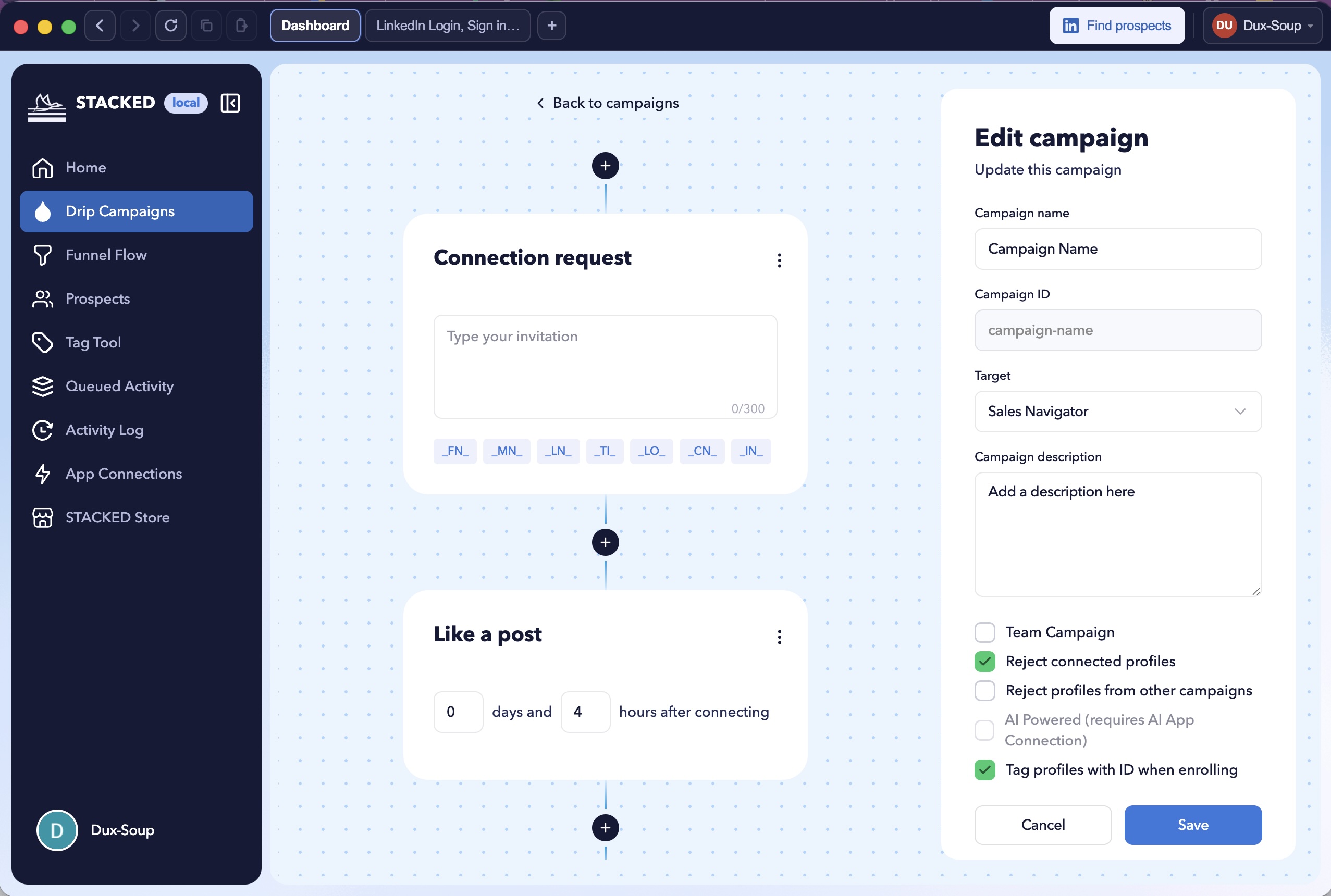
This means you can build a recruitment sequence that runs over time rather than manually carrying out every step for every candidate.
For example:
Find candidates → visit their profile → send a connection request → follow up → send a message → continue the conversation
You can create different campaigns for different roles or candidate groups, allowing your outreach to stay relevant to the people you're contacting.
STACKED also includes AI-powered message personalisation, campaign management, lead management and integrations with tools such as HighLevel.
The idea isn't to automate the human part of recruitment.
It's to spend less time on repetitive admin and more time having conversations with the candidates who are actually interested.
LinkedIn vs XING: which should recruiters use?
There's no single answer that applies to every recruiter.
The right platform depends on your recruitment market and the candidates you're trying to reach.
If you're recruiting internationally
LinkedIn's global network makes it a natural option when you're recruiting across multiple countries.
You can search for candidates in different markets without having to switch between different platforms.
If you're recruiting in Germany, Austria or Switzerland
XING deserves consideration because of its strong focus on the DACH market and its large German-speaking professional network.
For recruiters focused heavily on DACH, it can be a useful part of the sourcing mix.
If you're proactively sourcing candidates
Both platforms support active sourcing, so compare the search functionality, candidate availability and outreach options for the particular roles you're hiring for.
If you want to automate LinkedIn outreach
STACKED can help automate LinkedIn prospecting and candidate outreach, including campaigns built around Recruiter and regular LinkedIn searches.
So, LinkedIn or XING?
Rather than thinking about LinkedIn and XING as competing platforms where you have to choose one, it can be more useful to think about them as different sources of talent.
If your recruitment is global, LinkedIn gives you access to a much broader international network.
If you're focused on DACH, XING provides a dedicated German-speaking talent pool.
And if LinkedIn is already an important part of your sourcing strategy, automation can help you make better use of the time you spend building candidate lists and reaching out to them.
The most important thing is to start with the right candidates.
Find the right people. Send relevant messages. Follow up consistently. Spend your time on the conversations that matter.
That's where LinkedIn automation can make a difference.
Want to automate your LinkedIn recruitment?
STACKED, powered by Dux-Soup, helps recruiters find relevant candidates on LinkedIn, automate personalised outreach and manage follow-up campaigns.