How to Use LinkedIn Automation for Recruitment: A Complete Guide for Recruiters
LinkedIn is one of the most valuable platforms available to recruiters. Whether you're working for a recruitment agency, an executive search firm or an in-house talent acquisition team, it provides access to an enormous pool of potential candidates.
But finding the right people is only the beginning.
Recruiters also need to build relationships, send connection requests, follow up with prospective candidates, assess their suitability and maintain relationships with clients. Managing all these activities manually can consume a significant amount of time.
That's where LinkedIn automation for recruitment can make a real difference.
Using a LinkedIn automation platform like STACKED, recruiters can automate repetitive prospecting and outreach activities, build personalized candidate engagement campaigns and manage their LinkedIn recruitment pipeline more efficiently.
Rather than spending hours manually visiting profiles, sending connection requests and remembering to follow up, recruiters can establish repeatable workflows that help them focus on what matters most: building relationships and making successful placements.
In this guide, we'll explore how to use LinkedIn automation throughout the recruitment lifecycle, from building your candidate network to identifying, engaging and qualifying the right people.
What is LinkedIn automation for recruitment?
LinkedIn automation for recruitment is the use of software to automate repetitive LinkedIn activities involved in candidate sourcing and engagement.
Organising prospects using tags and campaign lists.
Monitoring candidate engagement and responses.
STACKED is a LinkedIn automation platform that helps recruiters organise and automate these activities through multi-step campaigns.
It supports LinkedIn, Sales Navigator and LinkedIn Recruiter workflows, allowing recruiters to build targeted candidate lists and enroll suitable profiles into outreach campaigns.
Its features include AI-powered message personalization, automated follow-ups, campaign analytics, prospect management and integrations with other business applications.
Importantly, automation should support the recruitment process rather than replace the human interaction that makes successful recruitment possible.
1. Building and maintaining your candidate network
Recruitment is a relationship-driven business.
Experienced recruiters understand the value of maintaining a large, relevant network of professional contacts. Someone who isn't considering a move today might be the perfect candidate for a role six months from now.
Building that network consistently is therefore essential.
However, expanding your LinkedIn network manually can be time-consuming. Searching for people, visiting their profiles, sending connection requests and keeping track of previous interactions all take valuable time.
This is where LinkedIn automation can help.
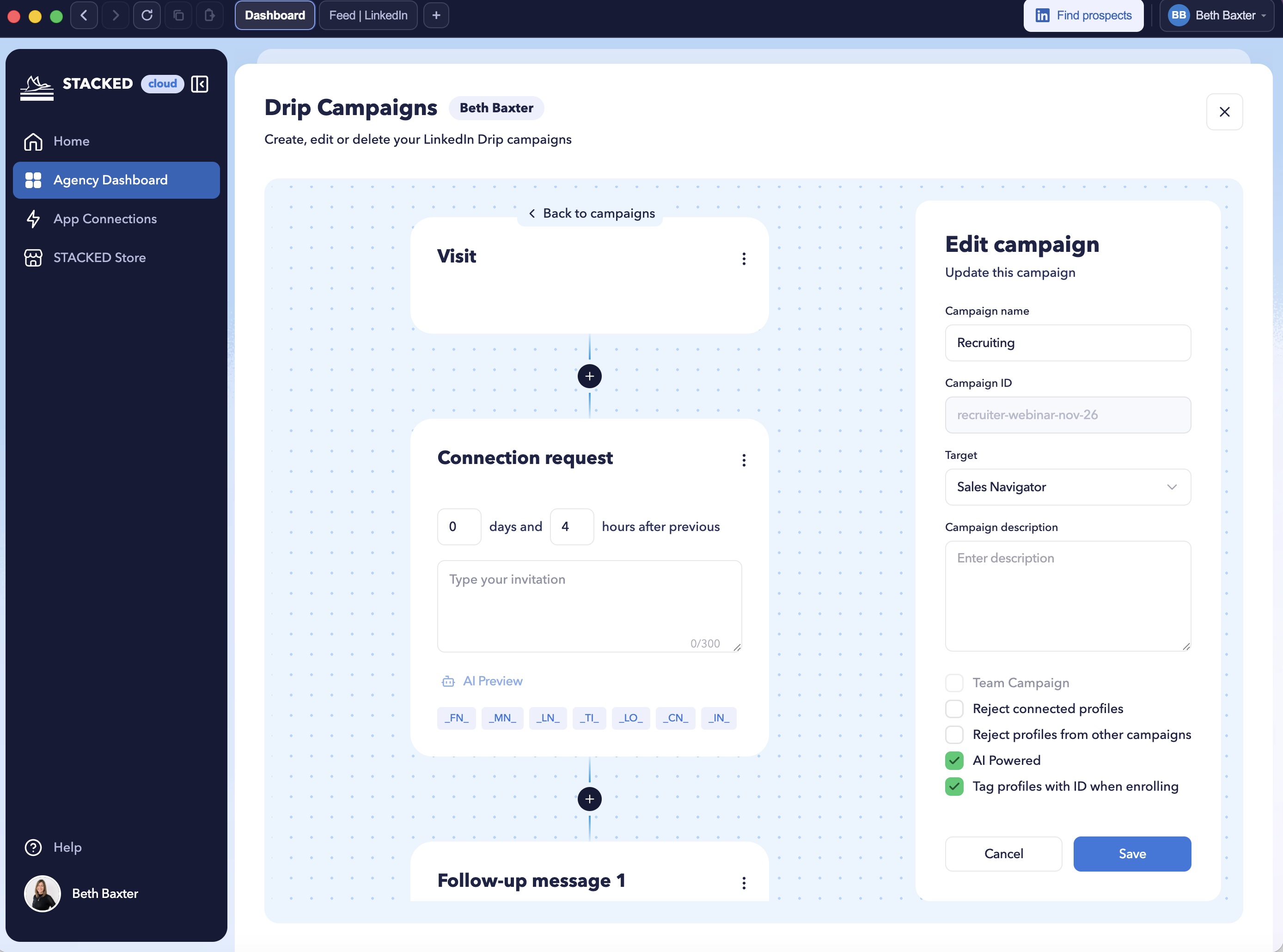
With STACKED, recruiters can create campaigns that automate profile visits, connection requests and subsequent engagement.
For example, a recruiter specialising in technology could build a targeted LinkedIn search for software engineers, technology directors or cloud infrastructure specialists.
Once the relevant profiles have been identified, they can be enrolled into a STACKED campaign.
The campaign can then carry out a sequence of activities, such as:
Visit the candidate's LinkedIn profile.
Send a personalized connection request.
Wait for the connection to be accepted.
Send an introductory message.
Schedule a further follow-up where appropriate.
This creates a consistent approach to network building without requiring recruiters to manage every individual action manually.
The benefit: Recruiters can steadily expand their professional networks and develop relationships with potential candidates before a suitable vacancy even arises.
2. From client brief to candidate search
When a new client brief arrives, speed matters.
The quicker a recruiter can identify suitable candidates and present a credible shortlist, the quicker they can move the recruitment process forward.
The first step is usually to search existing candidate networks and databases.
LinkedIn Recruiter is particularly useful here because it allows recruiters to apply detailed search filters to identify people based on criteria such as:
Current and previous job titles.
Industry and sector.
Location.
Skills and experience.
Current and previous employers.
Keywords and specialist expertise.
Open to Work preferences, where visible.
However, searching for candidates is only one part of the process. Recruiters also need an efficient way to organise those profiles and initiate contact.
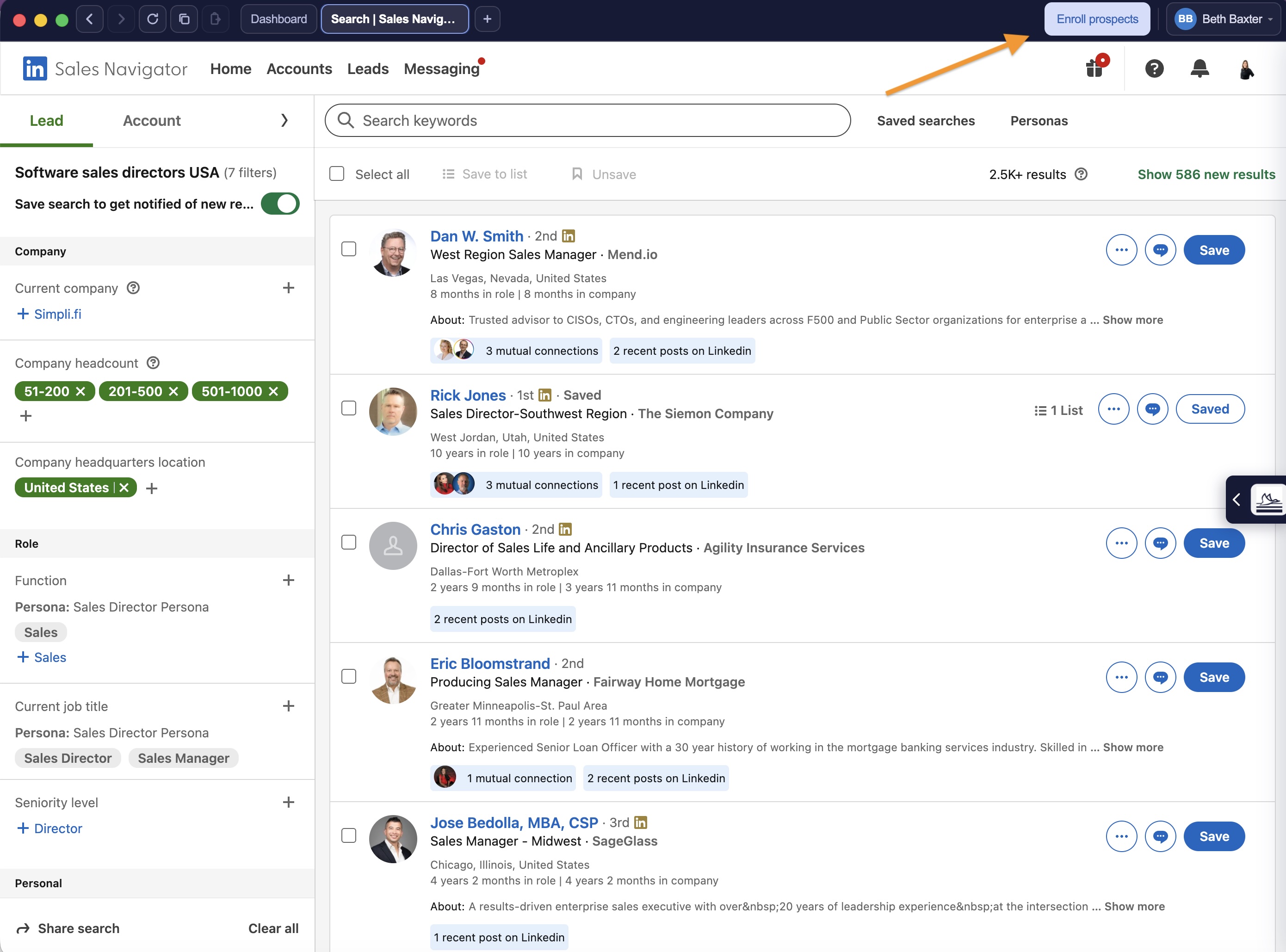
STACKED makes it possible to enroll candidates directly from LinkedIn People Search, Sales Navigator and LinkedIn Recruiter into an appropriate outreach campaign.
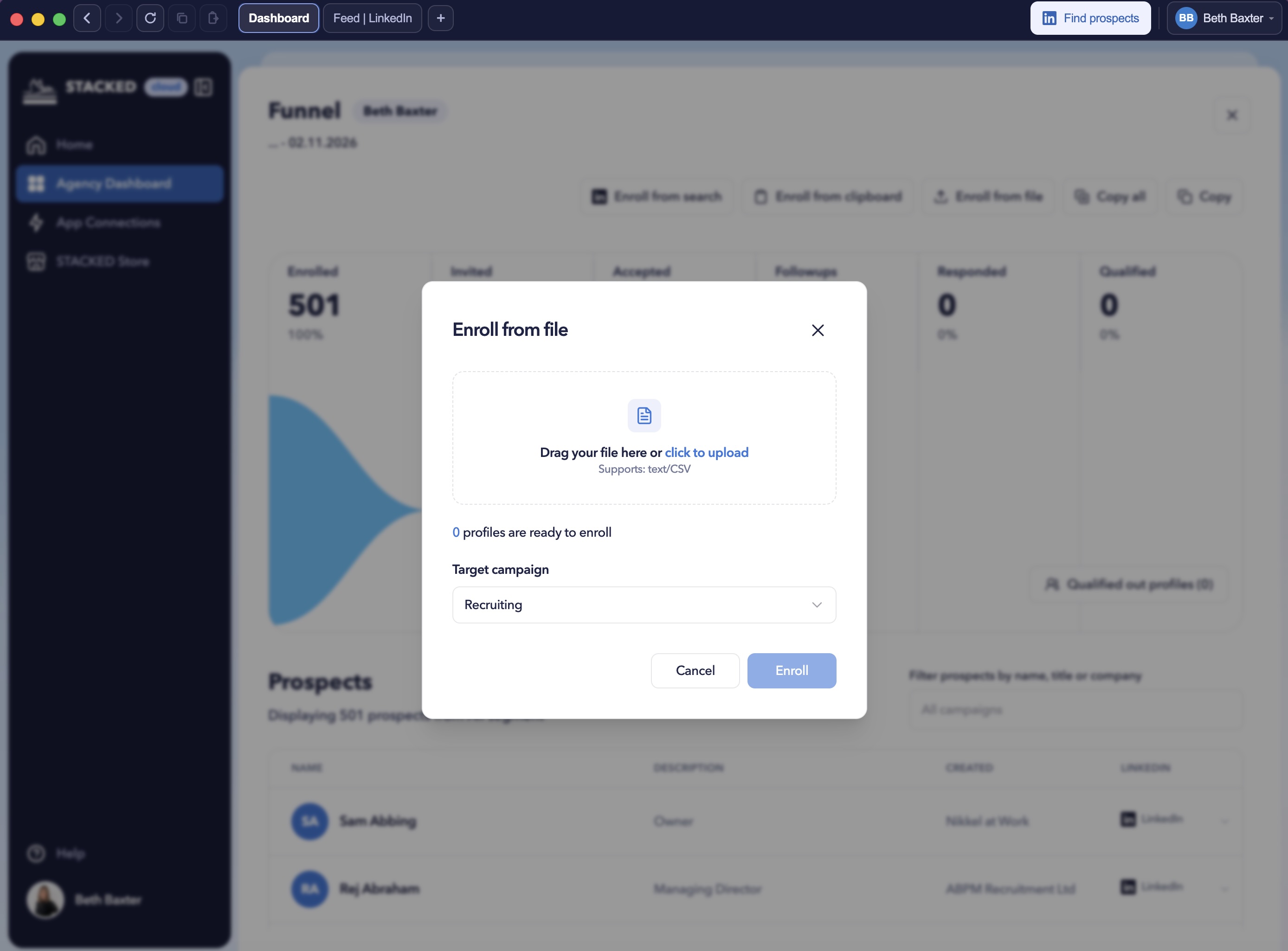
Recruiters can also add prospects to a campaign using profile pasted URLs, uploaded CSV filesor manually selected profiles.
This makes it easier to turn a LinkedIn search into an organised candidate outreach workflow.
Recruitment in action: Building a repeatable sourcing process
Imagine receiving a brief for a senior IT infrastructure manager.
Rather than manually approaching each potential candidate, the recruiter could:
Search LinkedIn Recruiter using relevant job titles, skills and location filters.
Review the search results and identify suitable profiles.
Enroll selected candidates into a dedicated STACKED campaign.
Use personalized connection requests to introduce themselves.
Follow up with candidates who accept their invitation.
Review responses and identify people interested in discussing the opportunity.
This approach is particularly useful for specialist recruitment agencies that regularly recruit for similar roles or operate across multiple sectors.
3. Connecting with passive candidates
One of the biggest challenges in recruitment is finding candidates who aren't actively looking for a new position.
These passive candidates can be particularly valuable because they may have the experience and expertise required for a role without necessarily appearing on traditional job boards.
LinkedIn provides access to many of these professionals, but identifying and approaching them requires a targeted strategy.
Recruiters can use LinkedIn's search functionality to identify suitable profiles and then use STACKED to organise and manage their outreach.
For example, a recruiter looking for a financial services director might create a search based on:
Relevant seniority and job titles.
Financial services experience.
Specific geographical markets.
Previous leadership positions.
Relevant technical or commercial skills.
Once the search is complete, suitable profiles can be enrolled into a STACKED campaign.
Depending on the campaign structure and the candidate's LinkedIn connection status, STACKED can automate profile visits, follows, connection requests, InMails and follow-up messages.
This allows recruiters to develop a more consistent approach to reaching people who might otherwise be difficult to engage.
Why personalized candidate outreach matters
Automation should never mean sending generic messages to hundreds of unrelated people.
Candidates are much more likely to engage with recruiters who demonstrate an understanding of their background and experience.
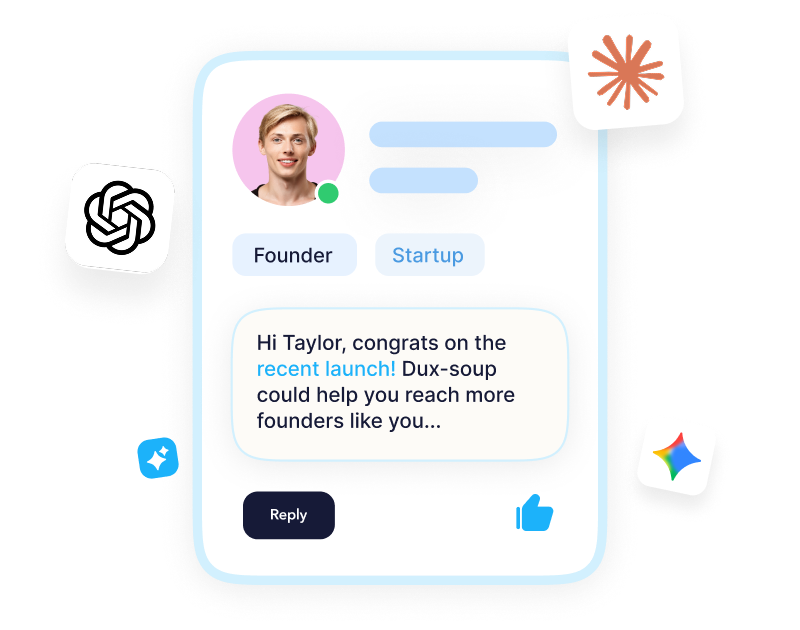
STACKED supports personalized messaging, including AI-powered message personalization, helping recruiters tailor their outreach to individual prospects.
For example, rather than sending:
"Hi John, I have an exciting opportunity that I think might interest you. Are you available for a chat?"
A more targeted approach might be:
"Hi John, I noticed your experience leading cloud infrastructure projects within financial services. I'm currently working on a senior technology leadership opportunity that looks relevant to your background. Would you be open to hearing a little more?"
The second message gives the candidate a reason to engage because it establishes a connection between their experience and the opportunity.
Personalization should always be based on accurate, relevant information. STACKED offers a native integration with Claude, ChatGPT and Gemini which allows AI to individually tailor each outreach message based on a prospect's LinkedIn profile data before sending it. It's all designed to get more responses thanks to the relevancy of the message. And it's working.
4. Engaging and qualifying candidates
Getting a connection request accepted is not the end goal.
The real objective is to start a conversation and establish whether the candidate might be suitable for the opportunity.
This is where a structured follow-up process becomes particularly valuable.
Without automation, recruiters must remember who has accepted a connection request, who needs a follow-up and who has already responded.
When managing hundreds of prospective candidates, this quickly becomes difficult.
STACKED allows recruiters to create multi-step LinkedIn campaigns that combine connection requests, messages, InMails and other engagement activities.
Campaigns can include scheduled delays between actions, helping recruiters create a consistent outreach process.
No forgetting to follow-up, only seamless professional and reliable engagement tactics.
A typical candidate engagement workflow might look like this:
STAGE
ACTIVITY
OBJECTIVE
1. Discovery
Identify relevant candidates
Build a targeted shortlist
2. Introduction
Send a personalized connection request
Establish contact
3. Engagement
Send an introductory message
Start a conversation
4. Follow-up
Send a relevant follow-up
Encourage a response
5. Qualification
Review candidate interest and suitability
Identify potential matches
6. Placement process
Arrange a call or interview
Identify potential matches
STACKED also provides campaign tracking and prospect management features to help recruiters understand where candidates are within the outreach process.
Its Funnel Flow functionality allows recruiters to monitor stages such as enrolled, invited, accepted, responded and qualified.
This makes it easier to identify which candidates need attention and which campaigns are generating meaningful engagement.
The important distinction: STACKED can automate the initial outreach and follow-up process, but candidate screening, interviews, reference checks and final selection should remain human-led.
5. Managing candidate relationships and recruitment pipelines
A successful recruitment business needs more than a database of LinkedIn connections.
It needs a structured way to manage relationships and understand which candidates are relevant to current and future opportunities.
STACKED includes prospect management functionality that allows recruiters to organise candidates using tags, campaign membership and funnel stages.
For example, a recruitment consultant could organise prospects using tags such as:
Senior IT leadership.
Software engineering.
Financial services.
Open to opportunities.
Future candidate.
Client introduction.
Contacted.
These categories make it easier to identify relevant candidates when a new brief arrives.
Recruiters can search and filter their prospect database, review campaign activity and export prospect information for use in other systems.
STACKED also supports integrations with other applications, helping businesses connect LinkedIn outreach with their wider technology stack.
It is worth remembering that a prospect management system is not necessarily a replacement for a dedicated applicant tracking system (ATS). Instead, STACKED can complement existing recruitment software by helping manage the LinkedIn prospecting and engagement stages.
6. Measuring recruitment outreach performance
One of the biggest advantages of LinkedIn automation is the ability to measure activity and identify opportunities for improvement.
Recruiters often have a good understanding of how many calls they make or interviews they arrange, but have less visibility over the effectiveness of their initial candidate outreach.
STACKED provides campaign analytics that help users monitor important performance indicators, including:
Connection requests sent.
Connection acceptance rates.
Messages sent.
Candidate responses.
Qualified prospects.
Campaign performance.
This information can help recruiters understand which approaches are working.
For example:
If one campaign generates a higher connection acceptance rate than another, it may indicate that the candidate targeting or connection message is more relevant.
If candidates accept connection requests but rarely respond to subsequent messages, the follow-up strategy may need reviewing.
If a particular candidate search generates few suitable prospects, the recruiter may need to refine their LinkedIn filters.
Over time, this information can help recruitment teams develop more effective sourcing and engagement strategies.
The objective isn't simply to increase the number of messages sent. It's to improve the quality of conversations that lead to successful placements.
7. The candidate's perspective: Why targeted outreach matters
Automation can improve recruiter productivity, but there is an important consideration that should never be overlooked: the candidate's experience.
Candidates receive a considerable amount of unsolicited LinkedIn outreach, particularly in competitive sectors such as IT, finance and professional services.
A generic connection request is unlikely to stand out.
A message that demonstrates an understanding of someone's experience, career history and professional interests is much more likely to receive attention.
Aslam Osman, Head of Marketing at Dux-Soup, highlights the importance of relevant recruiter approaches:
"The recruiters that have used the information in my profile to accurately match my skillset to the job opportunity are far more likely to be given the time of day."
He also noted that poorly targeted messages, particularly those referencing outdated experience, were quickly dismissed.
This illustrates an important principle:
The best LinkedIn recruitment automation strategy is not about contacting more people indiscriminately. It's about making relevant, personalised approaches to the right candidates.
STACKED can help recruiters automate repetitive outreach activities, but the quality of the search criteria, messaging and recruitment strategy remains essential.
8. Best practices for using LinkedIn automation in recruitment
LinkedIn automation can save time, but it needs to be implemented thoughtfully.
Here are some practical recommendations for recruitment teams.
1. Start with a clearly defined candidate profile
Before launching a campaign, establish exactly who you want to reach. Use relevant job titles, skills, locations and experience criteria to create targeted searches.
2. Personalise your connection requests
Avoid generic messages. Reference something relevant about the candidate's professional background and explain why you're getting in touch.
3. Build sensible follow-up sequences
Not everyone will respond immediately. Create a structured follow-up process, but avoid overwhelming candidates with repeated messages.
4. Monitor campaign performance
Review acceptance rates, response rates and qualified candidates. Use the information to refine your targeting and messaging.
5. Respond to interested candidates personally
Automation should handle repetitive tasks, not meaningful conversations. When a candidate expresses interest, take the conversation forward yourself.
6. Respect LinkedIn's rules and candidate privacy
Use sensible activity limits, respect platform restrictions and comply with applicable data protection requirements, including UK GDPR where relevant. Automation cannot guarantee that an account will never be restricted, so recruiters should monitor activity and prioritise responsible use.
7. Keep your recruitment database organised
Use tags and campaign segmentation to make it easier to find relevant candidates when new client briefs arrive.
Frequently asked questions about LinkedIn automation for recruitment
What is the best LinkedIn automation tool for recruiters?
The right LinkedIn automation tool depends on the size of your recruitment operation and the activities you want to automate.
STACKED is designed to help recruiters automate LinkedIn prospecting, connection requests, personalised messaging and follow-ups. It also includes campaign analytics, prospect management and integrations with other applications.
It supports workflows involving LinkedIn, Sales Navigator and LinkedIn Recruiter.
Can you automate LinkedIn Recruiter?
Yes. Recruiters can use STACKED to enrol candidates from LinkedIn Recruiter searches and candidate lists into outreach campaigns.
STACKED can then manage supported outreach activities, including connection requests through candidates' regular LinkedIn profiles, as well as other campaign actions depending on the workflow.
Can LinkedIn automation find passive candidates?
LinkedIn automation can help recruiters identify and engage passive candidates by combining targeted LinkedIn searches with automated outreach campaigns.
Recruiters can use LinkedIn Recruiter and Sales Navigator filters to find professionals with relevant skills, experience and job titles, then use STACKED to organise and contact selected candidates.
Can LinkedIn connection requests and follow-up messages be automated?
Yes. STACKED supports multi-step campaigns that can include personalised connection requests, messages, InMails, profile visits, follows and scheduled follow-ups.
The available actions depend on the candidate's connection status and the type of campaign being used.
Does LinkedIn automation replace an applicant tracking system?
No. LinkedIn automation and applicant tracking systems (ATS) serve different purposes.
LinkedIn automation helps recruiters find and engage prospective candidates. An ATS is designed to manage the wider recruitment process, including applications, interviews and hiring workflows.
STACKED can complement an existing ATS by helping manage candidate sourcing and initial engagement.
How can recruiters personalise automated LinkedIn messages?
Recruiters can use candidate profile information, relevant experience and role requirements to create more targeted messages.
STACKED supports message personalisation and AI-powered messaging, helping recruiters create outreach that is more relevant to each individual.
Messages should always be checked for accuracy and relevance before being sent.
Is LinkedIn automation safe for recruiters?
LinkedIn automation needs to be used responsibly. Recruiters should respect LinkedIn's terms and activity limits, avoid excessive outreach and ensure that messages are relevant and appropriate.
STACKED includes account safety controls and configurable activity settings, but we recommend sticking with our preconfigured safety settings.
Conclusion: Make LinkedIn recruitment more efficient with STACKED
Recruitment will always involve a significant amount of relationship-building, communication and candidate assessment.
But that doesn't mean every part of the process needs to be manual.
LinkedIn automation can help recruitment agencies and in-house talent teams reduce repetitive administrative work, maintain larger candidate networks and establish more consistent approaches to candidate engagement.
STACKED brings these activities together through automated LinkedIn campaigns, AI-powered personalisation, prospect management and campaign analytics.
From identifying potential candidates and sending connection requests to managing follow-ups and monitoring responses, STACKED helps recruiters organise their LinkedIn recruitment activity in one place.
Most importantly, it gives recruiters more time to concentrate on the activities that really make a difference: speaking to candidates, understanding their career ambitions, managing client relationships and making successful placements.
Ready to make your LinkedIn recruitment process more efficient?
Discover STACKED and see how LinkedIn automation can help you build a more consistent, organised and scalable candidate sourcing process.